Justine, in a paragraph.
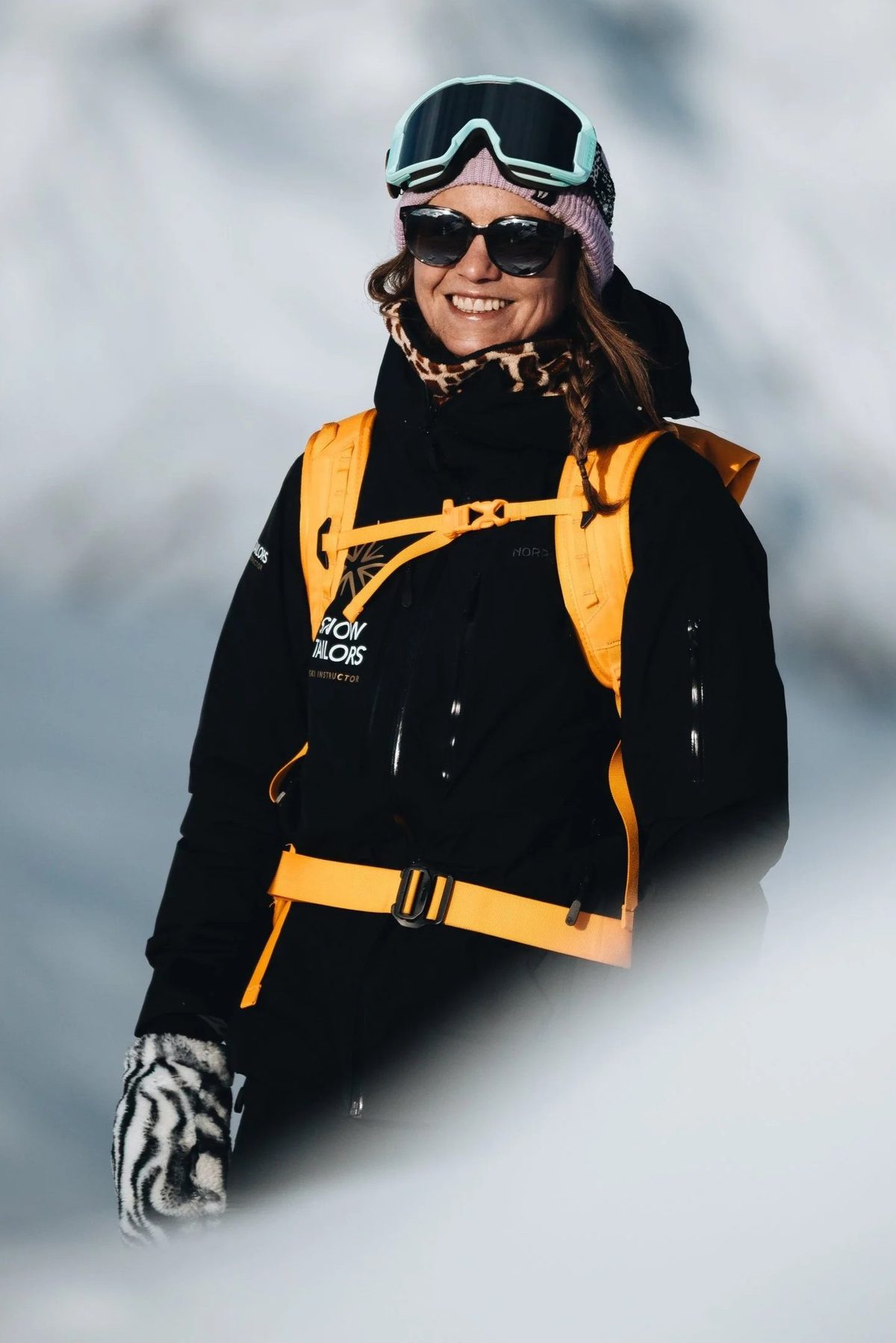
Justine grew up in the Bauges, the small range of pre-Alps north of Chambéry, the eldest of four children and — by the testimony of her younger siblings — already, at twelve, a patient and slightly theatrical instructor. She was teaching her brother to ski before her own parents had thought to enrol her. She has, in some sense, been doing this her whole life.
She holds the Diplôme d'État from the École Nationale de Ski et d'Alpinisme, and a secondary qualification in early-childhood pedagogy obtained at the Université Savoie Mont Blanc — a course not commonly held by ski instructors and taken, in her case, because she wanted to better understand the four- and five-year-olds she had already been teaching for several years. The combination is rare. The result, on the slope, is a kind of patience that does not feel like patience at all.
Justine works in French and English, and is the instructor we send when a family is arriving with the youngest children of the household. She has spent the better part of a decade working the gentle beginner zones of Courchevel — the Pralong magic carpet — and of Méribel — the Altiport — and knows the timing of the lift queues, the warm-up windows in the sun, and the location of every small hot-chocolate stand within a five-minute ski of either zone.
What the families remember most, after a week with her, is rarely the technical progression. It is, almost always, the way she made the child want to come back the next morning. She is, on the practical question of skiing, an excellent technical instructor. On the harder question of making a child love the sport, she is the best person we know.
How she teaches a 4-year-old to ski.
The first morning with a four-year-old does not, in Justine's hands, look like a ski lesson. It looks like a long story, told in instalments, with the child as the central character. The child is, in the story, a small mountain explorer who has been called upon to climb a very gentle hill. The hill, in real life, is the magic carpet at Pralong. The story continues all morning. Skiing happens, almost incidentally, in the spaces between.
By the third or fourth run, the child has stopped thinking about the skis on their feet and is thinking about the next chapter of the story. By the seventh or eighth run, they have learned to slow down without being told to slow down — because the small explorer in the story has reached the edge of a quiet meadow and needs to walk softly. By the tenth run, parents at the café below the magic carpet are watching their four-year-old turn, stop and turn again, without help, and quietly wondering when this happened. It happened an hour ago. The child has not noticed yet.
Justine's method, beneath the theatre, is precise. She introduces a maximum of three technical ideas per morning — usually two — and she introduces them by physical metaphor rather than by instruction. (A wedge becomes a slice of pizza. Edges become "the side of the foot that says hello to the snow.") She watches the child's body temperature constantly, and ends the morning twenty minutes before the child would have asked to. She does not push. She does not bargain. She lets the child want more.
Parents, during the morning, are usually at the café fifty metres down the slope — close enough to wave, far enough not to be present. This is by design. Justine has found, over ten years of teaching, that a four-year-old learns faster and trusts more quickly when the parent is not in the line of sight. The arrangement works, in our experience, almost every time. The exception is the child who has not yet skied at all, in which case Justine asks one parent to be present for the first thirty minutes only — and to leave, quietly, once the first turn has been made.
Her favourite scenes.
Justine has two favourite places to teach a beginner child in the 3 Valleys, and she will choose between them based on which village the family is staying in. The first is the Pralong beginner zone above Courchevel — long magic carpets, gentle south-facing gradient, and a café (Le Pralong) that has been making the same hot chocolate, in the same small cups, for twenty years. The second is the Altiport zone above Méribel — slightly cooler, slightly quieter, surrounded by larch trees and with the Altiport runway in the background, which children find endlessly fascinating.
For families based in Val Thorens, she works the Cascades and Plein Sud beginner zones — slightly busier than Pralong, but with the advantage of altitude (snow is more reliable in December). She has worked these zones often enough to know which of the magic carpets is the gentlest at any given hour, and where to position the family for the morning sun.
In the words of her guests.
Our four-year-old asked, on the morning of our flight home, when we would see Justine again. We told her in eleven months. She nodded, accepted this, and asked us if we could send Justine a drawing in the meantime. We did. Justine wrote back. A returning guest, Brussels — chalet in Courchevel
By the third day our daughter was not just skiing — she had stopped being afraid. Justine had done that without us noticing. We do not know how. We are simply grateful. A first-week family, London — chalet in Méribel
Where you'll ski with her.
Justine's calendar is structured around two villages. Courchevel — the Pralong beginner zone, the long blue runs of Verdons for the children who have outgrown the magic carpet — accounts for slightly more than half of her winter. Méribel — the Altiport zone, the forested blue runs of the Chaudanne side — accounts for most of the rest. She works in Val Thorens, Saint-Martin and Les Menuires on rotation, by family request.
- Courchevel — the Pralong magic carpet for first-timers, the Verdons blues for children who have skied before, and the long descent to Courchevel-Le Praz for the families who want to combine the morning lesson with a quiet lunch.
- Méribel — the Altiport zone for first-timers, and the gentle blue runs through the larch forests of the Chaudanne for families with mixed-level children.
- Val Thorens, Saint-Martin, Les Menuires — taught on rotation, more often during the deepest weeks of winter when the lower villages are less reliable on snow.
Working with Justine.
To request Justine specifically, mention her name in your enquiry. Her calendar fills first for the February school weeks — when families with school-age children are travelling in greatest number — followed by Christmas and New Year. For the quieter weeks of January and late March, she is more easily available with shorter notice.
Language pairing: French or English, equally fluent. She works most often with French, British, American and Belgian families. For Italian-speaking families with very young children, she pairs the family with Marion Levasseur or Fabrice Galofaro on Day Two and takes the parents in Italian — but the morning with the four-year-old is always Justine's, in English or in French.
Format: Justine works in mornings (3 hours), full days (with a long, child-sized lunch included), and the popular split-day arrangement — she takes the children in the morning, the parents in the afternoon, and the family meets again at the chairlift at 3 p.m. She recommends ending the day no later than 4 p.m. for under-sixes; the last hour is, in her experience, where small skiers fall and lose confidence. She keeps an eye on the temperature curve and on the child's appetite. Both, she will tell you, predict the next day's lesson.