Why we teach snowboard properly.
Most ski schools teach snowboard as a courtesy — a Tuesday afternoon afterthought, run by a ski instructor who happens to have passed the snowboard module ten years ago. The result is what most adult snowboarders describe as a frustrating first week, a sore wrist, and the conviction that the sport is not for them. None of that is the sport's fault.
Snowboard is its own discipline. The body addresses the slope sideways. The edges work in a continuous motion rather than the alternating dynamic of skiing. The fall pattern is different — and unlike skiing, poor instruction in the first three days will produce habits that take years to undo. We treat snowboard with the seriousness it deserves because, in our experience, the difference between a good first week and a bad one is essentially the instructor.
Our snowboard team is small — three full-time specialists rather than thirty generalists — and each holds the relevant French state qualification. They have, between them, taught beginner mornings and advanced backcountry for fifteen seasons each. Grégoire Socquet, our all-mountain lead, is also a regular contact point for guests transitioning from skiing to snowboarding mid-life, which is more common than you might expect.
The first three days of snowboarding shape every habit you'll have on the board for the next decade. That is why we teach it slowly, and never alongside a ski lesson. Grégoire Socquet, all-mountain lead
The four disciplines we cover.
A Snowtailors snowboard week can address any of the following — separately, or in combination, depending on the guest. Most weeks involve two or three of these strands rather than one alone.
Carving
The classical discipline. Long, clean turns on hard pack — the part of snowboarding that most resembles high-speed skiing, and the foundation on which the other disciplines rest. We work this on the wide groomed blues and reds of Val Thorens (Plein Sud, Christine), and in the Méribel valley on the Cherferie face when the snow is dry.
Freestyle — jumps, boxes, rails
The Mottaret park, in the Méribel valley, is the best freestyle setup in the 3 Valleys. There are graded kickers (small, medium, large), boxes and rails, and in good winters a half-pipe. Our freestyle progression starts on the small kickers and a flat box, never on the medium feature, and is taught with a slowness that most parents quietly thank us for.
Backcountry and freeride snowboard
La Masse and the Cime Caron face are skiable on a snowboard with the right equipment — splitboard or traditional with a short skin section — and our two backcountry-specialist instructors are happy to organise a freeride day for advanced riders. The full avalanche kit and protocol is identical to the ski off-piste programme.
Telemark
Two of our instructors hold the Brevet d'État telemark specialisation and offer telemark on request. It is best taken as a multi-day project — the technique reconditions the legs and one lesson rarely converts a skier completely. The reward, when it lands, is a manner of skiing that is graceful in a way few other things are.
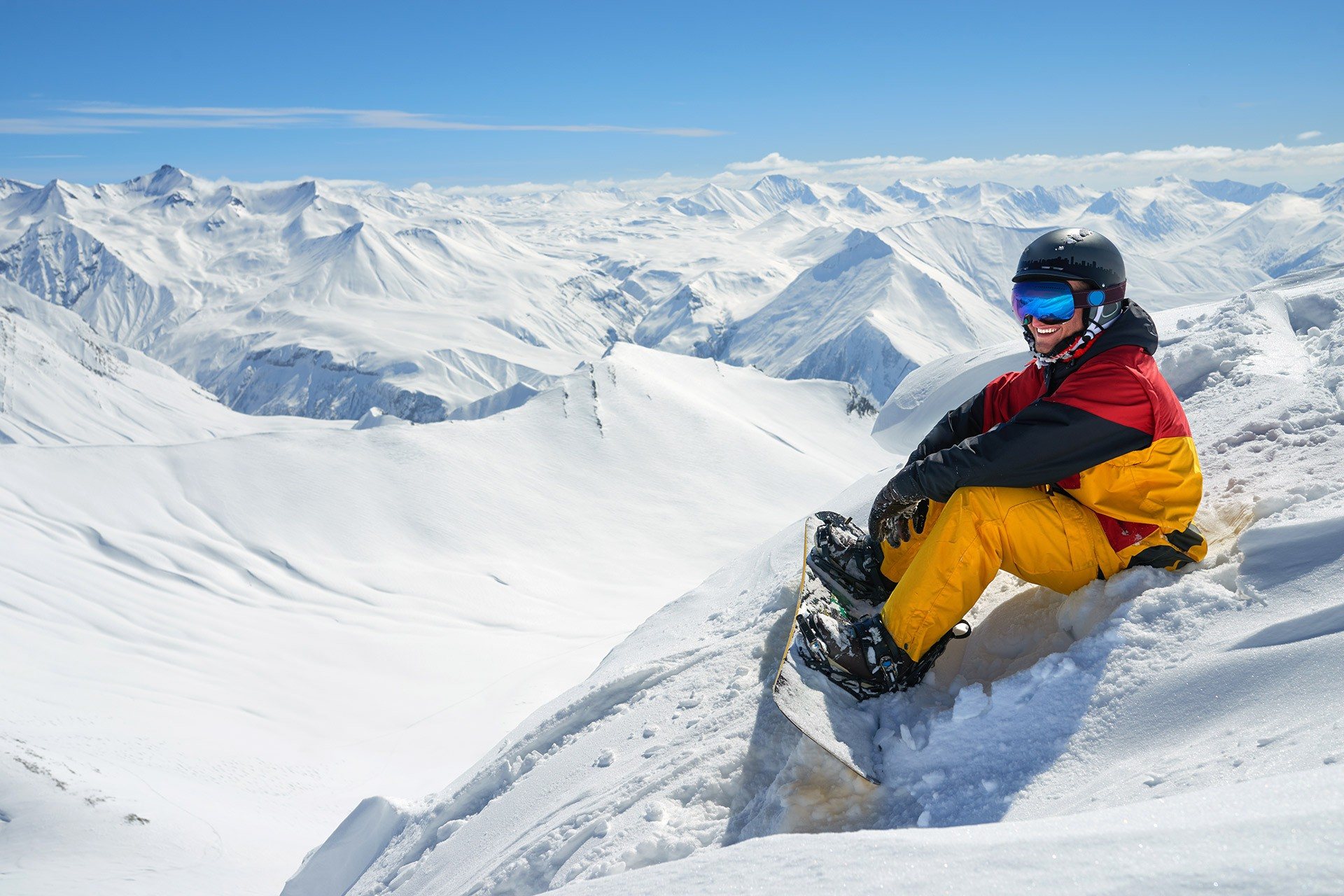
Optional GoPro filming, slow-motion at lunch.
On request, your instructor brings a GoPro Hero 12 — chest-mounted, helmet-mounted or off the snow on a tripod — and films selected sections of the morning. At lunch, on a tablet over coffee, we play back the slow-motion footage and discuss what is working and what is not. Visual feedback is, in our experience, worth two hours of verbal correction.
The footage is yours to keep — sent at the end of the week via a private link. We do not post anything on social media, ever, without explicit written consent, and we have never asked for it. The filming exists for technical review, and for the modest pleasure of watching yourself ski well in the season's last light.
What it costs, openly.
Snowboard tariffs are identical to skiing tariffs — a deliberate decision. The skill of teaching the sport properly does not vary by discipline, and we will not penalise the snowboarder in your party for the choice they made.
- Half-day morning (09:00–12:00, 3 hours) — from €80 per hour, all-inclusive.
- Half-day afternoon (13:00–17:00, 4 hours) — from €75 per hour, the same instructor across the afternoon.
- Full day (09:00–17:00, 8 hours including lunch coordination) — from €600 per day.
- The Tailored Week (5 or 6 days, the same instructor) — on quotation, with continuity discount.
- Specialised programmes (telemark, freestyle, backcountry) — on quotation.
- GoPro filming option — on request, included in the day rate when arranged 48 hours ahead.
High-season periods — Christmas, February, Easter — are tariffed higher. We will quote transparently before booking.
Boards, boots, and the importance of fitting.
We do not sell or rent equipment — we coordinate it. The single most important item, by some distance, is the boot. A poorly fitted snowboard boot ruins a week, and is the most common reason a guest stops enjoying the sport. We always book a thirty-minute fitting slot at one of two shops we trust personally:
- Skiloc Val Thorens — for guests staying in Val Thorens, Saint-Martin or Les Menuires. Patrice runs the shop and the boot wall, and is one of the best fitters in the valley.
- Sport 2000 La Croisette, Courchevel 1850 — for guests staying in Courchevel or Méribel. Family-run, four generations, with a quiet appointment room rather than the public counter.
Boards are matched to weight, riding style and discipline. For first-time riders we use forgiving softer boards (135-145 cm depending on weight); for advanced riders we move to stiffer all-mountain boards in the 155-160 cm range; for backcountry, splitboards are available on request. The fitting is timed before the first lesson, never on the morning itself — we have learned this the hard way.