Fabrice, in a paragraph.
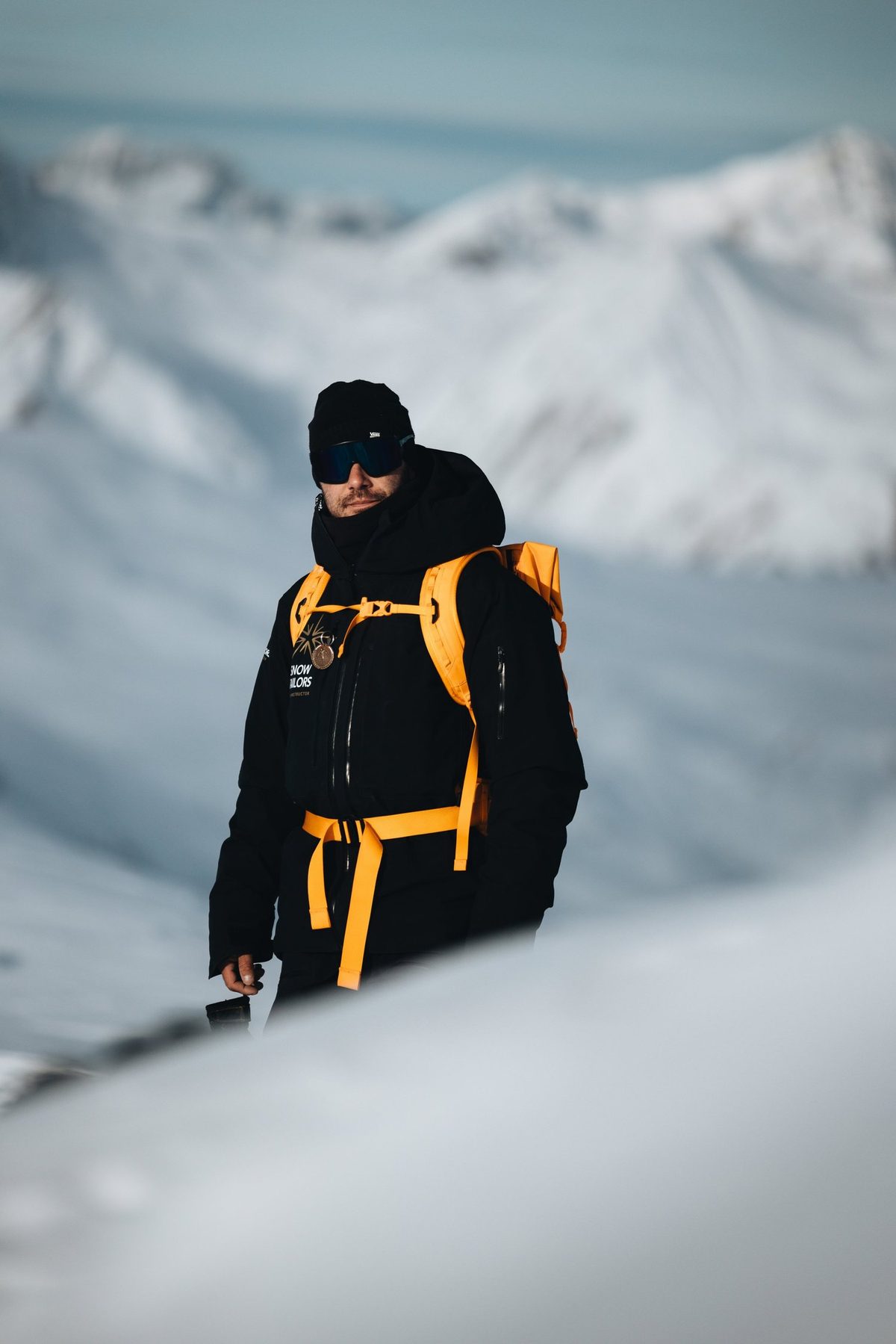
Fabrice grew up in Bardonecchia, on the Italian side of the Col de l'Échelle, in a family of three generations of competitive skiers. He raced on the junior circuit until eighteen, on the FIS circuit until his early twenties, and then made the same decision many former racers make in their mid-twenties — to coach rather than compete. He has, by his own account, never quite stopped competing in the small sense — every set of training poles still gets a mental clock attached to it.
He holds the Diplôme d'État from the École Nationale de Ski et d'Alpinisme, and the DEJEPS race coaching diploma — the French national qualification for ski-racing coaches, held by most of the working coaches of the regional ski federations. He is one of two instructors on the team to hold the racing diploma, and the only one whose calendar is built around it.
Fabrice teaches in French, English and Italian. He works most often with families from Milan, Turin, Geneva and London — and with two or three established adult-amateur racers who book him for the same week of focused training every January. He runs three formats: the three-day intensive (the most common), the five-day racing block (his preferred), and the weekly programmes with families whose teenagers compete on a regional circuit.
What he is not, for the avoidance of doubt, is a stadium drill instructor. He is a former racer who has watched the sport at the very top end and has strong views about how an amateur should train. The training is technical, deliberate, and gentler on the body than it sounds. Most of the work happens in the morning. The afternoon is, by his preference, free skiing on terrain chosen to reinforce that morning's correction.
His training method.
Fabrice's three-day intensive is structured, in his shorthand, around three letters: G, P, V. Day one is geometry — line, terrain reading, the choice of where to go before the choice of how to ski it. Day two is pressure — the timing and degree of edge engagement, the management of body position above and below the ski. Day three is video — a long lunch session with the recordings of days one and two, played back at quarter-speed, with annotations and one or two specific corrections to take into the afternoon.
The five-day block extends the same logic and adds two further elements: a session of timed runs on the Reberty stadium clocks, and a final morning of free skiing on chosen terrain (the Roc de Fer descent, the Saulire couloirs, the Cime Caron face) with the specific goal of applying the week's work in unfamiliar snow. Most amateur racers who book Fabrice for five days are looking for the timed runs as the centrepiece. Most leave saying it was the morning on the Saulire that taught them most.
The weekly format is, in practice, the format most parents of competitive teenagers request — Fabrice working with the teenager for a focused morning in the stadium, then either freeing the afternoon (so the teenager can ski with the family) or extending it into a full coaching session with video review at the chairlift between runs. The weekly format is the only one Fabrice runs in February school weeks, when the racing teenagers travel in greatest number.
Video review is, in every format, the part Fabrice considers indispensable. He records on two cameras — one mounted at the top of the stadium, one held below the third gate — and reviews the runs at lunch over a long table at the Reberty café (Les Menuires) or at the reserved Folie Douce window (Méribel). He sends the annotated clips to the family the same evening. He has, in his own words, never coached a guest who did not improve faster for having seen the recording than for having heard the correction.
His favourite gates.
Fabrice has three preferred training stadiums in the 3 Valleys, and he chooses between them by the level and the goal of the guest. The Reberty stadium in Les Menuires is his workhorse — accessible from a single chairlift, well groomed, and with the lift queue and timing infrastructure required to run a serious training morning. The Roc de Fer in Méribel is steeper and more demanding (the venue, in 2023, of the World Cup women's descent) and is the stadium he uses for older teenagers and adult Masters racers who are already comfortable with technical terrain. The Saulire training poles above Courchevel, finally, are his choice for guests who want to combine race training with a high-altitude free-skiing afternoon — the long red descent off the Saulire summit is, in his view, the best free-skiing finish to a coaching morning anywhere in the domain.
In the words of his guests.
I am fifty-four years old and I had not skied this well at twenty-five. Three days, in language so plain it almost felt like ordinary conversation, and I was a different skier. An adult amateur, Geneva — Masters racer, third winter with Fabrice
Our son's regional coach told us to find a private week with someone who knew how the international circuit thinks. We found Fabrice. The coach was right. A guest family, Milan — son on the Italian junior circuit
Where you'll ski with him.
Fabrice's calendar is anchored in two villages. Les Menuires — and specifically the Reberty stadium — accounts for slightly more than half of his winter. Méribel — and specifically the Roc de Fer training piste — accounts for most of the rest. Courchevel, with the Saulire training poles and the long descents off the Verdons, is held for the families who specifically request it.
- Les Menuires (Reberty stadium) — Fabrice's most-used venue. Run in coordination with the village stadium operators, with timed runs on request.
- Méribel (Roc de Fer) — for older teenagers and adult amateurs ready for steeper, faster terrain. Strong post-lunch free-skiing options off the Tougnète and Saulire.
- Courchevel (Saulire training poles) — the high-altitude stadium of the 3 Valleys, paired with the long red descent of the Saulire summit. Reserved for guests who want race coaching and free-ski exploration in the same week.
Working with Fabrice.
To request Fabrice specifically, mention his name in your enquiry. His calendar is most heavily booked from the second week of January through the first week of March — the heart of the racing season. Outside that window he is more easily available, and many of our adult amateur clients book him for an early-December training block before the lifts are properly busy.
Language pairing: French, English or Italian, equally fluent. He works most often with Italian-speaking families and with the adult amateur racing community of Geneva and the Lake Geneva basin.
Format: three-day intensive, five-day racing block, or weekly with split mornings. Video review is included in all formats. Timed runs at the Reberty stadium are arranged with the village authorities — Fabrice sends the recorded times by SMS within the hour. Lift passes and equipment (we recommend a stiffer race ski for the dedicated training days) are arranged by our concierge in coordination with our partner shop in Les Menuires.